Resolv Integrates Janus Henderson Anemoy AAA CLO Fund
Overview
Resolv has embedded AAA-rated institutional credit directly into onchain money markets via Centrifuge, deploying up to $100M of Janus Henderson’s tokenized AAA CLO fund (JAAA) and leveraging it within Aave Horizon as institutional-grade collateral.
Representing one of the largest real-world asset loop trades executed in DeFi to date, this marks a structural shift: institutional-grade credit is no longer passive exposure — it is now actively leveraged, composable collateral inside decentralized markets, expanding DeFi’s yield engine beyond crypto-native assets.
Background: Convergence of Global Finance and Onchain Money Markets
The convergence between global finance and onchain money markets is no longer theoretical. Tokenized real-world assets are increasingly embedded into decentralized liquidity venues, and leverage infrastructure onchain has matured to institutional standards.
Today, decentralized lending markets provide:
Transparent collateral frameworks
Continuous liquidity
Programmatic leverage
Cross-border capital mobility
At the same time, traditional financial instruments — including investment-grade credit products — are becoming accessible in tokenized form.
Bridging these systems requires more than asset access. It requires disciplined underwriting, active risk management, and deep familiarity with onchain funding mechanics.
Resolv’s strategy is built around that intersection: integrating investment-grade global assets into a structured, actively managed onchain yield framework.
Integrating JAAA
Resolv addresses this by allocating capital to Janus Henderson’s Anemoy AAA CLO Fund (JAAA) via its RWA cluster.
Leverage through Aave (Horizon instance) will form an integral part of the deployment. We target leverage levels of up to 80% loan-to-value (LTV), within structured and actively monitored risk parameters.
This allocation is a highly capital-efficient strategy built around investment grade collateral and transparent funding rails.
Deeper Dive: What Is Anemoy JAAA?
Janus Henderson Anemoy AAA CLO Fund (JAAA) invests in AAA-rated tranches of collateralized loan obligations (CLOs).
The fund is managed by Janus Henderson Investors, a global asset manager with extensive experience in structured credit. Janus Henderson operates the largest AAA CLO strategy globally, with approximately $27B in assets under management in the AAA CLO Exchange-traded fund (ETF), launched in 2020.
This scale is relevant for several reasons:
Deepest expertise in the market
Unmatched access to primary and secondary CLO markets
Broad diversification across managers and issuance vintages
Institutional-grade portfolio construction and oversight
The fund infrastructure is built up by a team of Anemoy, a web3 native asset manager, and Centrifuge, a protocol specializing in bringing real-world assets onchain. Centrifuge provides the legal, structural, and technical framework that enables regulated financial products to be represented and integrated within decentralized liquidity venues.
Centrifuge has been one of the earliest and most active platforms focused specifically on RWA tokenization, with multiple institutional integrations across onchain money markets. Its infrastructure is designed to bridge traditional asset managers and decentralized capital pools while maintaining clear legal structuring.
Structural Characteristics
Underlying collateral: senior secured corporate loans
Position in capital structure: top (AAA tranche)
Coupon structure: floating rate linked to short-term base rates (SOFR)
AAA tranches sit at the top of the CLO capital stack. Losses must first be absorbed by equity and mezzanine tranches before affecting AAA holders. In roughly three decades of CLO market history, there have been no reported defaults in the AAA and AA tranches.
This structural hierarchy — combined with floating-rate income — is central to the risk profile of the instrument and was a primary focus of our due diligence.
Economic Snapshot: Credit Resilience and Rates Profile
Our due diligence focused on credit history, structural protections, and stress behavior.
1. Credit Performance Across Cycles
Historically, U.S. AAA-rated CLO tranches have demonstrated extremely low default and principal impairment rates, including through:
The 2008–2009 financial crisis
The March 2020 liquidity shock
While secondary market prices experienced temporary volatility during stress periods, principal impairment for AAA tranches in modern CLO structures has been negligible.
2. Floating-Rate Income Profile
AAA CLO coupons float with short-term base rates.
This has two implications:
Income increases when policy rates rise
Duration risk is materially lower than fixed-rate bonds
The floating-rate characteristic reduces sensitivity to rate shocks and provides an external rate engine independent of crypto-native funding dynamics.
Economics After Leverage
The allocation combines:
Investment-grade floating-rate structured credit
Onchain leverage via Aave Horizon
Conservative LTV discipline (up to 80%)
Historically, AAA CLO yields have offered a structural spread above short-term funding benchmarks. When paired with disciplined leverage at moderate LTV levels, this spread capture improves capital efficiency without introducing junior credit exposure.
We do not publish forward return targets. However, historical relationships between JAAA yields and short-term funding costs demonstrate the durability of the carry profile under prudent leverage assumptions.
Rate Diversification and Sustainability
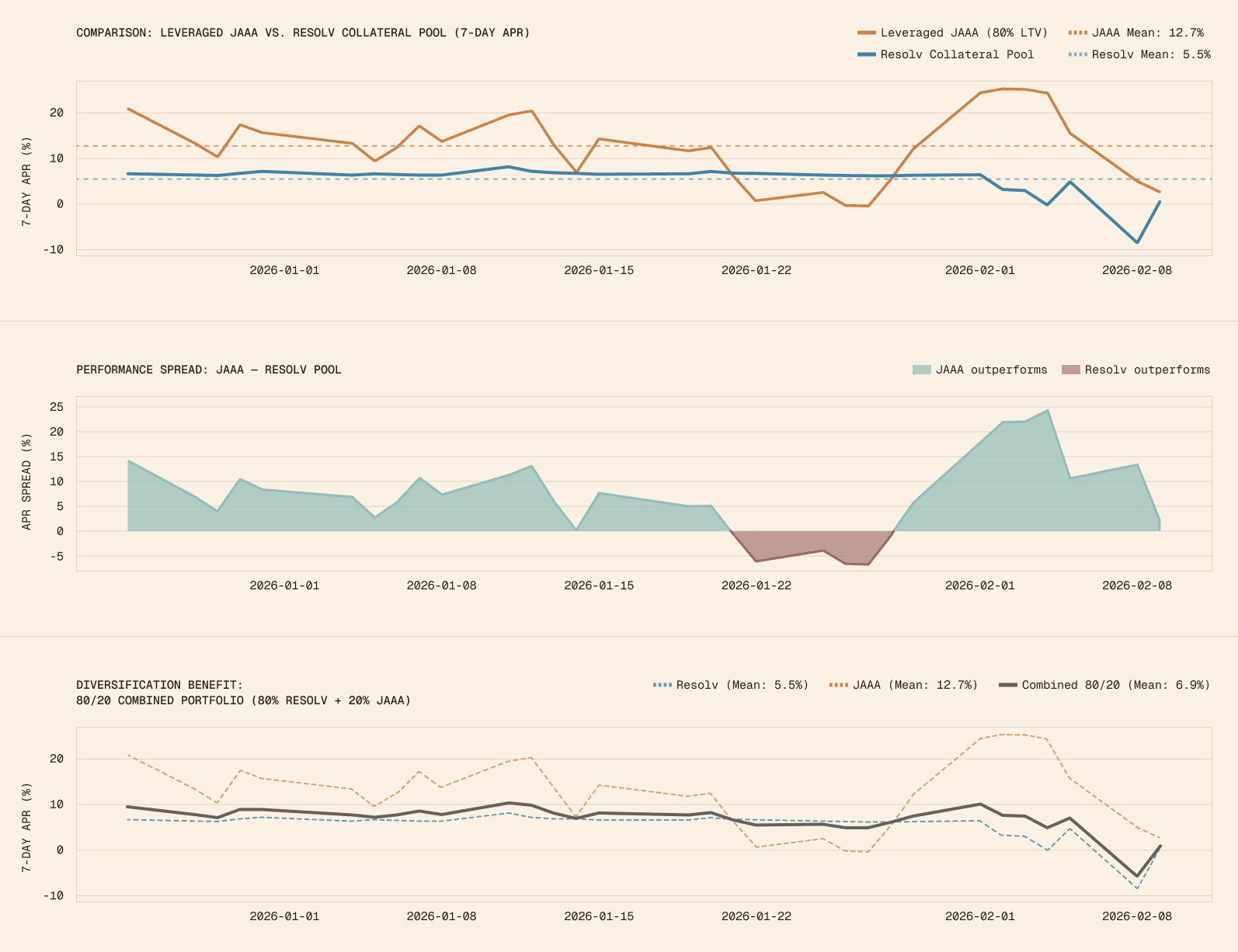
An additional rationale for this allocation is diversification of rate exposure outside of digital asset native asset rates.
Crypto-native lending rates are primarily driven by:
Digital asset leverage demand
Volatility cycles
Liquidity imbalances
In contrast, AAA CLO yields are driven by:
U.S. base rates (SOFR)
Corporate credit spreads
Broader macroeconomic conditions
These rate engines are structurally distinct.
By incorporating floating-rate structured credit exposure, Resolv reduces reliance on purely crypto-native yield cycles and strengthens the sustainability of its income profile across market regimes.
This diversification is particularly relevant in environments where crypto borrowing demand compresses or becomes unstable.
Risk Framework
Key risks monitored within this deployment include:
Spread widening in US Credit markets
Temporary mark-to-market volatility
Funding cost on Aave Horizon
Leverage parameters are structured to maintain significant collateral buffers. Continuous monitoring of funding costs and credit conditions forms part of the active risk management process.
The objective remains capital preservation and stability before yield optimization.
Next Steps: Building a Liquid Yield Engine
Resolv is building a liquid yield engine anchored in:
Institutional-grade underwriting process
Structured capital efficiency
Access to prime leverage venues
Diversification across markets
The integration of Janus Henderson AAA CLO Fund represents a focused expansion of the investment-grade component of this framework.
Current efforts remain concentrated on direct underwriting and disciplined allocation to high-quality assets. Over time, we expect further diversification across additional asset classes and structured instruments that meet our underwriting standards.
Further updates will follow as allocations scale and additional integrations are completed.
Overview
Resolv has embedded AAA-rated institutional credit directly into onchain money markets via Centrifuge, deploying up to $100M of Janus Henderson’s tokenized AAA CLO fund (JAAA) and leveraging it within Aave Horizon as institutional-grade collateral.
Representing one of the largest real-world asset loop trades executed in DeFi to date, this marks a structural shift: institutional-grade credit is no longer passive exposure — it is now actively leveraged, composable collateral inside decentralized markets, expanding DeFi’s yield engine beyond crypto-native assets.
Background: Convergence of Global Finance and Onchain Money Markets
The convergence between global finance and onchain money markets is no longer theoretical. Tokenized real-world assets are increasingly embedded into decentralized liquidity venues, and leverage infrastructure onchain has matured to institutional standards.
Today, decentralized lending markets provide:
Transparent collateral frameworks
Continuous liquidity
Programmatic leverage
Cross-border capital mobility
At the same time, traditional financial instruments — including investment-grade credit products — are becoming accessible in tokenized form.
Bridging these systems requires more than asset access. It requires disciplined underwriting, active risk management, and deep familiarity with onchain funding mechanics.
Resolv’s strategy is built around that intersection: integrating investment-grade global assets into a structured, actively managed onchain yield framework.
Integrating JAAA
Resolv addresses this by allocating capital to Janus Henderson’s Anemoy AAA CLO Fund (JAAA) via its RWA cluster.
Leverage through Aave (Horizon instance) will form an integral part of the deployment. We target leverage levels of up to 80% loan-to-value (LTV), within structured and actively monitored risk parameters.
This allocation is a highly capital-efficient strategy built around investment grade collateral and transparent funding rails.
Deeper Dive: What Is Anemoy JAAA?
Janus Henderson Anemoy AAA CLO Fund (JAAA) invests in AAA-rated tranches of collateralized loan obligations (CLOs).
The fund is managed by Janus Henderson Investors, a global asset manager with extensive experience in structured credit. Janus Henderson operates the largest AAA CLO strategy globally, with approximately $27B in assets under management in the AAA CLO Exchange-traded fund (ETF), launched in 2020.
This scale is relevant for several reasons:
Deepest expertise in the market
Unmatched access to primary and secondary CLO markets
Broad diversification across managers and issuance vintages
Institutional-grade portfolio construction and oversight
The fund infrastructure is built up by a team of Anemoy, a web3 native asset manager, and Centrifuge, a protocol specializing in bringing real-world assets onchain. Centrifuge provides the legal, structural, and technical framework that enables regulated financial products to be represented and integrated within decentralized liquidity venues.
Centrifuge has been one of the earliest and most active platforms focused specifically on RWA tokenization, with multiple institutional integrations across onchain money markets. Its infrastructure is designed to bridge traditional asset managers and decentralized capital pools while maintaining clear legal structuring.
Structural Characteristics
Underlying collateral: senior secured corporate loans
Position in capital structure: top (AAA tranche)
Coupon structure: floating rate linked to short-term base rates (SOFR)
AAA tranches sit at the top of the CLO capital stack. Losses must first be absorbed by equity and mezzanine tranches before affecting AAA holders. In roughly three decades of CLO market history, there have been no reported defaults in the AAA and AA tranches.
This structural hierarchy — combined with floating-rate income — is central to the risk profile of the instrument and was a primary focus of our due diligence.
Economic Snapshot: Credit Resilience and Rates Profile
Our due diligence focused on credit history, structural protections, and stress behavior.
1. Credit Performance Across Cycles
Historically, U.S. AAA-rated CLO tranches have demonstrated extremely low default and principal impairment rates, including through:
The 2008–2009 financial crisis
The March 2020 liquidity shock
While secondary market prices experienced temporary volatility during stress periods, principal impairment for AAA tranches in modern CLO structures has been negligible.
2. Floating-Rate Income Profile
AAA CLO coupons float with short-term base rates.
This has two implications:
Income increases when policy rates rise
Duration risk is materially lower than fixed-rate bonds
The floating-rate characteristic reduces sensitivity to rate shocks and provides an external rate engine independent of crypto-native funding dynamics.
Economics After Leverage
The allocation combines:
Investment-grade floating-rate structured credit
Onchain leverage via Aave Horizon
Conservative LTV discipline (up to 80%)
Historically, AAA CLO yields have offered a structural spread above short-term funding benchmarks. When paired with disciplined leverage at moderate LTV levels, this spread capture improves capital efficiency without introducing junior credit exposure.
We do not publish forward return targets. However, historical relationships between JAAA yields and short-term funding costs demonstrate the durability of the carry profile under prudent leverage assumptions.
Rate Diversification and Sustainability
An additional rationale for this allocation is diversification of rate exposure outside of digital asset native asset rates.
Crypto-native lending rates are primarily driven by:
Digital asset leverage demand
Volatility cycles
Liquidity imbalances
In contrast, AAA CLO yields are driven by:
U.S. base rates (SOFR)
Corporate credit spreads
Broader macroeconomic conditions
These rate engines are structurally distinct.
By incorporating floating-rate structured credit exposure, Resolv reduces reliance on purely crypto-native yield cycles and strengthens the sustainability of its income profile across market regimes.
This diversification is particularly relevant in environments where crypto borrowing demand compresses or becomes unstable.
Risk Framework
Key risks monitored within this deployment include:
Spread widening in US Credit markets
Temporary mark-to-market volatility
Funding cost on Aave Horizon
Leverage parameters are structured to maintain significant collateral buffers. Continuous monitoring of funding costs and credit conditions forms part of the active risk management process.
The objective remains capital preservation and stability before yield optimization.
Next Steps: Building a Liquid Yield Engine
Resolv is building a liquid yield engine anchored in:
Institutional-grade underwriting process
Structured capital efficiency
Access to prime leverage venues
Diversification across markets
The integration of Janus Henderson AAA CLO Fund represents a focused expansion of the investment-grade component of this framework.
Current efforts remain concentrated on direct underwriting and disciplined allocation to high-quality assets. Over time, we expect further diversification across additional asset classes and structured instruments that meet our underwriting standards.
Further updates will follow as allocations scale and additional integrations are completed.
